About Internal Quality Assurance Cell (IQAC)
- Since the establishment of the Internal Quality Assurance Cell (IQAC), Mody University of Science and Technology has been at the forefront of fostering quality consciousness across all its domains. In recent years, the university has experienced substantial growth in its offerings and enrolment, significant improvements in infrastructure, remarkable expansion in research activities, and enhanced accreditation and visibility. This impressive development is a result of the unwavering efforts of the top management, faculty, staff, and students, all guided by the meticulous and forward-thinking planning of the IQAC, particularly in quality initiatives and data management.
- IQAC at Mody University ensures the effective implementation of quality initiatives through continuous reviews and periodic meetings, striving for excellence in all academic and administrative endeavours of the institution.
- At Mody University, the IQAC is dedicated to enhancing the quality of education delivered, aligning its efforts with the university’s pioneering initiatives for women’s education and its philosophy of blending the best practices, along with adhering to statutory guidelines and directives.
Objectives
- To develop a system for conscious, consistent and catalytic action to improve the academic and administrative performance of the institution.
- To promote measures for institutional functioning towards quality enhancement through internalization of quality culture and institutionalization of best practices
Vision
- To ensure quality culture as the prime concern for the Higher Education Institutions through institutionalizing and internalizing all the initiatives taken with internal and external support.
Strategies
Shall evolve mechanisms and procedures for:
- Ensuring timely, efficient and progressive performance of academic, administrative and financial tasks
- Relevant and quality academic/ research programmes
- Equitable access to and affordability of academic programmes for various sections of society
- Optimization and integration of modern methods of teaching and learning
- The credibility of assessment and evaluation process
- Ensuring the adequacy, maintenance and proper allocation of support structure and servicesbest
- Sharing of research findings and networking with other institutions in India and abroad
Functions
Some of the functions expected of the IQAC are:
- Development and application of quality benchmarks
- Parameters for various academic and administrative activities of the institution
- Facilitating the creation of a learner-centric environment conducive to quality education and faculty maturation to adopt the required knowledge and technology for participatory teaching and learning process
- Collection and analysis of feedback from all stakeholders on quality-related institutional processes
- Dissemination of information on various quality parameters to all stakeholders
- Organization of inter and intra institutional workshops, seminars on quality related themes and promotion of quality circles
- Documentation of the various programmes/activities leading to quality improvement
- Acting as a nodal agency of the Institution for coordinating quality-related activities, including adoption and dissemination of best practices
- Development and maintenance of institutional database through MIS for the purpose of maintaining /enhancing the institutional quality
- Periodical conduct of Academic and Administrative Audit and its follow-up
- Preparation and submission of the Annual Quality Assurance Report (AQAR) as per guidelines and parameters of NAAC
Benefits
Will facilitate / contribute to:
- Ensure clarity and focus in institutional functioning towards quality enhancement
- Ensure internalization of the quality culture
- Ensure enhancement and coordination among various activities of the institution and institutionalize all good practices
- Provide a sound basis for decision-making to improve institutional functioning
- Act as a dynamic system for quality changes in HEIs
- Build an organised methodology of documentation and internal communication
AQAR
- Students’ Satisfaction Survey 2022-2023
- AQAR 2022-2023
- Students’ Satisfaction Survey 2023-2024
- AQAR 2023-2024
Minutes of the Meeting and Action Taken Report
| 2016-17 | Minutes | |
| 2017-18 | Minutes | |
| 2018-19 | Minutes | |
| 2019-20 | Minutes | |
| 2020-21 | Minutes | |
| 2021-22 | Minutes | |
| 2022-23 | Minutes | ATR |
| 2023-24 | Minutes | ATR |
| 2024-25 | Minutes | ATR |
| 2024-25 | Minutes | ATR |
IQAC Quality Initiatives
| S.No. | Year | Name of the quality initiative by IQAC | Event Type | Duration |
|---|---|---|---|---|
| 1 | 2023 | NAAC Sponsored National Seminar on “Framework Guidelines for Preparation and Submission of IIQA, SSR and AQAR for NAAC Accreditation” | National Seminar | 27th November |
| 2 | 2024 | Workshop on Outcome Based Education | Workshop | |
| 3 | 2024 | TWO DAY NATIONAL SEMINAR ON Water, Soil and Biodiversity Conservation: A shared responsibility for sustainable future | National Seminar | 22-23 Feb 2024 |
| 4 | 2023 | Workshop on AI & IoT, Intel | Workshop | 9-13, October, 2023 |
| 5 | 2024 | Why AI is important to study for Computer Science Engineering, IBM | Workshop | 24 April 2024 |
| 6 | 2024 | Workshop on AI and IOT tools in Agricultural applications | Workshop | 26 April 2024 |
| 7 | 2023 | Centre for Women Leadership – Talk by Dr. Anamika Chauhan – Master Coach, PhD (IIT Bombay), Cognitive Scientist, Founder – Magnificent U | Seminar | August 19, 2023 |
| 8 | 2024 | Symposium on Bio-Diversity and Business Sustainability | Symposium | April 20, 2024 |
| 9 | 2025 | AICTE Sponsored 6-days ATAL online | FDP | 11 October 2025 |
NAAC
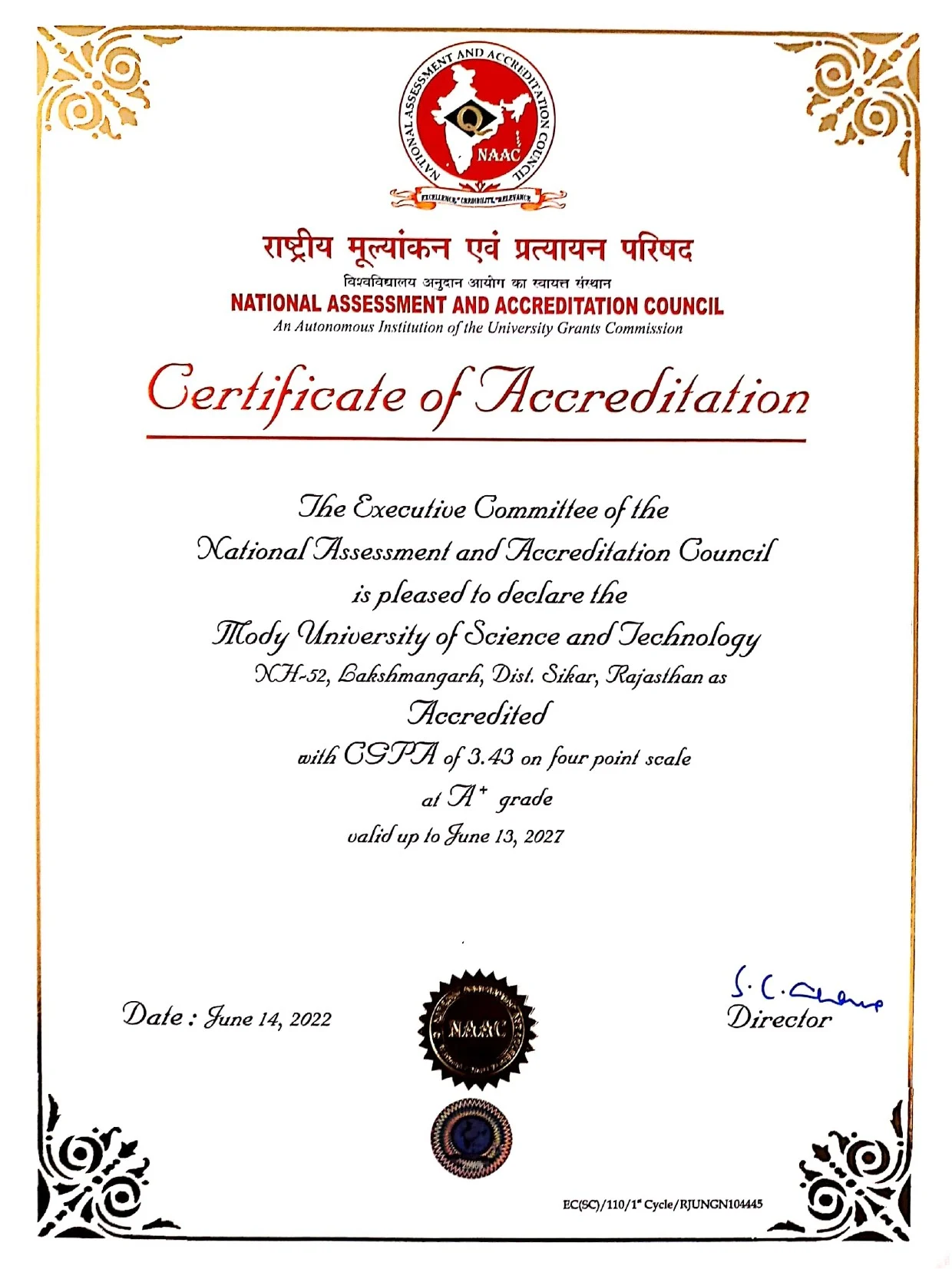
1st cycle 2022 : IIQA| SSR Report | Peer Team Report | Grade Sheet
NAAC SSR 2022 – Mody University of Science and Technology
1.1.1 – The Institution ensures effective curriculum delivery through a well planned and documented process
1.1.2 – % of Programs where Syllabus Revision in last 5 Yrs
1.1.3 – % of courses having focus on employability/entrepreneurship/ skill development offered by the University
1.2.1 – % of new Courses in last 5years
1.2.2 – % of Programs in which Choice Based Credit System (CBCS)/elective course system
1.3.1 – Institution integrates crosscutting issues relevant to Professional Ethics ,Gender, Human Values ,Environment and Sustainability into the Curriculum
1.3.2 – Value Added Course
1.3.3 – Average Percentage of students enrolled in the courses under 1.3.2 above
1.3.4 – % of Stud. Undertaking Field Projects/Internships, Current Year
1.4.1 – Structured feedback for design and review of syllabus – semester wise
1.4.2 – ACTION TAKEN FOR THE ANAYSIS OF FEEDBACK COLLECTED
2.1.1 – Demand Ratio (Average of last five years)
2.1.2 – Seats filled against reserved categories (SC, ST, OBC, Divyangjan, etc.) as per applicable reservation policy
2.2.1 – The institution assesses the learning levels of the students and organises special Programmes for advanced learners and slow learners”
2.2.2 – Student – Full time teacher ratio
2.3.1 – Student centric methods, such as experiential learning, participative learning and problem solving methodologies
2.3.2 – Teachers use ICT enabled tools including online resources for effective teaching and learning processes
2.3.3 – Ratio of students to mentor for academic and other related issues
2.4.1 – % of full time teachers against sanctioned posts
2.4.2 – % of full time teachers with Ph.D./D.M/M.Ch./D.N.B Superspeciality/D.Sc./D’Lit
2.4.3 – Teaching experience of full time teachers in the same institution
2.4.4 – % of full time teachers who received awards, recognition, fellowships at State, National, International level
2.5.1 – Number of days from the date of last semester-end/ year- end examination till the declaration of results
2.5.2 – % of student complaints/grievances about evaluation against total number appeared in the examinations
2.5.3 – IT integration and reforms in the examination procedures and processes
2.5.4 – Status of automation of Examination division along with approved Examination Manual
2.6.1 – The institution has stated learning outcomes
2.6.2 – Attainment of Programme outcomes, Programme specific outcomes and course outcomes are evaluated by the institution
2.6.3 – Pass percentage of students (Data for the latest completed academic year)
2.7.1 – Online student satisfaction survey regarding teaching learning process.
3.1.1 – Policy Doc towards Research Promotion
3.1.2 – Seed money to its teachers for research
3.1.3 – National/ international fellowship/financial support by various agencies for advanced studies/ research
3.1.4 – JRFs, SRFs, Post Doctoral Fellows, Research Associates and other research fellows enrolled in the institution
3.1.5 – Facilities to support research such as Central Instrumentation Centre, Animal House/Green House, Museum etc.
3.1.6 – Departments with UGC-SAP, CAS, DST-FIST, DBT, ICSSR and other recognitions by national and international agencies
3.2.1 – Extramural funding for Research
3.2.2 – Grants for research projects sponsored by the government agencies
3.2.3 – Research projects per teacher funded by government and non-government agencies
3.3.1 – Eco system for innovations including Incubation centre and other initiatives for creation and transfer of knowledge
3.3.2 – Workshops/seminars conducted on Research methodology, Intellectual Property Rights (IPR),entrepreneurship, skill development
3.3.3 – Number of awards / recognitions received for research/innovations by the institution/teachers/research scholars/students
3.4.1 – Code of Ethics for research
3.4.2 – Incentives to teachers who receive state, national and international recognitions/awards
3.4.3 – Patents published/awarded
3.4.4 – Ph.D’s awarded per teacher
3.4.5 – Research papers per teacher in the Journals notified by UGC
3.4.6 – Books and chapters in edited volumes published
3.4.7 – E-content developed by teachers
3.4.8 – Bibliometrics of the publications on average Citation Index in Scopus/ Web of Science/PubMed
3.4.9 – Bibliometrics of the publications during the last five years based on Scopus/ Web of Science – h-Index of the University
3.5.1 – Institution has a policy on consultancy including revenue sharing between the institution and the individual and encourages its faculty to undertake consultancy
3.5.2 – Revenue generated from consultancy and corporate training during the last five years (INR in Lakhs)
3.6.1 – Extension activities in the neighbourhood community
3.6.2 – Awards received by the Institution, its teachers and students
3.6.3 – Extension and outreach programs conducted by the institution
3.6.4 – Average percentage of students participating in extension activities listed at
3.6.3 above during the last five years
3.7.1 – Collaborative activities with other institutions/ research establishment/industry for research and academic
3.7.2 – MoUs with institutions/ industries in India and abroad
4.1.1 – Facilities for teaching – learning. viz., classrooms, laboratories, computing equipment, etc.
4.1.2 – Facilities for cultural activities, yoga, games (indoor, outdoor) and sports.
4.1.3 – General campus facilities and overall ambience
4.1.4 – Expenditures excluding salary for infrastructure augmentation
4.2.1 – Integrated Library Management System (ILMS) and has digitisation facility
4.2.2 – Subscription for e-Library resources
4.2.3 – Annual expenditure for purchase of books/ e-books and subscription to journals/e-journals
4.2.4 – % per day usage of library by teachers and students
4.3.1 – % of classrooms and seminar halls with ICT – enabled facilities
4.3.2 – IT Policy
4.3.3 – Student – Computer ratio
4.3.4 – Bandwidth of internet connection in the Institution
4.3.5 – Facilities for e-content development
4.4.1 – Average percentage expenditure incurred on maintenance of physical facilities and academic support facilities excluding salary
4.4.2 – Systems and procedures for maintaining and utilizing physical, academic and support facilities
5.1.1 – % of Students’ benefitted by Institution, Govt. Scholarships; NGO Avg; 5 Yrs
5.1.2 – % of students benefitted thro guidance for competitive exam/career Counseling
5.1.3 – Capacity development and skills enhancement initiatives
5.1.4 – Redressal of student grievances including sexual harassment and ragging cases
5.2.1 – % of students qualifying in state/ national/ international level examinations
5.2.2 – % of Placement during last 5 Yrs
5.2.3 – % of Students’ Progression to Higher Studies
5.3.1 – Awards at National/International, Sports/Cultural, 5 Yrs
5.3.2 – Student Council and its activities for institutional development and student welfare
5.3.3 – No. of Sports/Cultural Activities organized over last 5 Yrs, Ave
5.4.1 – Alumni Association/Chapters (registered and functional)
5.4.2 – Alumni Contribution, 5 Yrs; 100L; 50-100L; 20-50L; 5-20L; Less
6.1.1 – The Governance of Institution is reflective
6.1.2 – Decentralization Participative Management
6.2.1 – Institutional Strategic Plan
6.2.3 – Institution Implements e-governance in its areas of operations
6.3.1 – Performance appraisal system, promotional avenues and effective welfare measures for teaching and non-teaching staff
6.3.2 – % of Teachers given financial support for W/C/Prof.; 5 Yrs
6.3.3 – No. of FDP/Admin. Organized for Faculty/Staff; 5 Yrs, Average
6.3.4 – % of Teachers attending FDP; Orientation; Etc 5 Yrs
6.4.1 – Institutional strategies for mobilisation of funds and the optimal utilisation of resources
6.4.2 – Funds / Grants received from government bodies during the last five years for development and maintenance of infrastructure
6.4.3 – Funds / Grants received from non government bodies during the last five years for development and maintenance of infrastructure
6.4.4 – Internal and external financial audits
6.5.1 – IQAC – Significant Contributions – QA Strategies & Processes
6.5.2 – Institution has adopted the following for Quality assurance
6.5.3 – Incremental improvements made for the preceding five years with regard to quality
7.1.1 – Gender Equity Programs, last 5 Yrs
7.1.2 – Alternate Energy Initiatives – Renewable Energy Generation
7.1.3 – Facilities for the management of degradable and non-degradable waste
7.1.4 – Water conservation facilities
7.1.5 – Green campus initiatives
7.1.6 – Quality audits on environment and energy
7.1.7 – Physical facilities/Lift/Ramp/Braille/Rest/Scribes/Skill Dev; A
7.1.8 – Institutional efforts/initiatives in providing an inclusive environment i.e., tolerance and harmony towards cultural, regional, linguistic, communal socioeconomic
7.1.9 – Constitutional Obligations – Programs
7.1.10 – Code of Conduct HandBook for Students/Teachers/Administrators/Other staff
7.1.11 – National and international commemorative days, events and festivals
7.2.1 – 2 Best Practices
7.3.1 – Institutional Distinctiveness
2.1 – ENROLLMENT LIST OF FIVE YEARS
2.2 – OUTGOING FINAL YEAR STUDENTS FIVE YEARS
2.3 – STUDENTS APPERARED IN EXAMINATION FIVE YEARS
3.1 – Curriculum Structure
3.2 – Number of Full Time teachers currently working in the institute
3.2 (A) – DATE OF JOINING
3.2 (B) – DATE OF JOINING AND LEAVING
4.1 – NUMBER OF ELIGIBLE APPLICATION RECIEVED
4.2 – RESERVATION POLICY_MODY UNIVERSITY
NAAC Certificates